The Future of Learning Is Self-Directed Thinking
When our learning experiences move beyond absorbing information and proving it on high-stakes assessments, we come to understand ourselves, others, and the world around us in relation to what we are learning about.
Too often, education rewards performance and product over process. In a session I attended at the2026 ASU+GSV Summit this past week, Kori Street, Executive Director of the University of Southern California’s Center for Affective Neuroscience, Development, Learning, and Education referred to a study that saw that Math students conditioned for compliance experienced failure as devastation and the emotional experience immobilized them in their learning; whereas, math students who were more connected to what they were learning saw a mistake as another piece of information they had to build back into their learning experience.
How students do school
So many education models deliver learning that rewards how to follow instructions, meet expectations, and demonstrate understanding in ways that are easily measurable. But beneath that surface, something more important is also happening: young people are forming beliefs about what it means to learn, to think, and to know. At its best, self-regulated learning disrupts those assumptions, offering an invitation to question not just what we know, but how we know it, and who we are in the process.
In my undergraduate Literary Arts and Secondary Education degree, our professor exposed us to Khalil Gibran, whose poetry appealed to me as an aspiring teacher and one who came late to post-secondary education, inspired to enter the classroom by observing organic innate learning and teaching between my friends’ four-year old and his four month old little brother. Gibran proposes, “No man can reveal to you aught but that which already lies half asleep in the dawning of your knowledge.” Essentially, proposing that like Plato, he saw learning as an awakening of a sense of knowing that is dormant within us.
Gibran’s body of work captured my imagination because it awakened a hope that I would one day feel smart. Even though I was studying an undergratuate double degree in Literary Arts and Secondary Education, at a few points in my early education, I had a reading support tutor. I struggled with attention. I had always felt that I had to fake it to make it. But according to Gibran, I had it in me. A turning point for how I understood myself as a learner. A spark of curiosity: What if learning isn’t about receiving knowledge… but drawing it out, piecing things together?
That realization didn’t come from being told what to think so I could take a quiz and get an A. It came from being invited to reflect. To interpret. To sit with an idea and notice what it stirred in me. It was (although I didn’t have the language for it at the time) a moment of thinking about my own thinking. And it was one of those sticky experiences that I know was formative not only because it was powerful, but because it was rare.
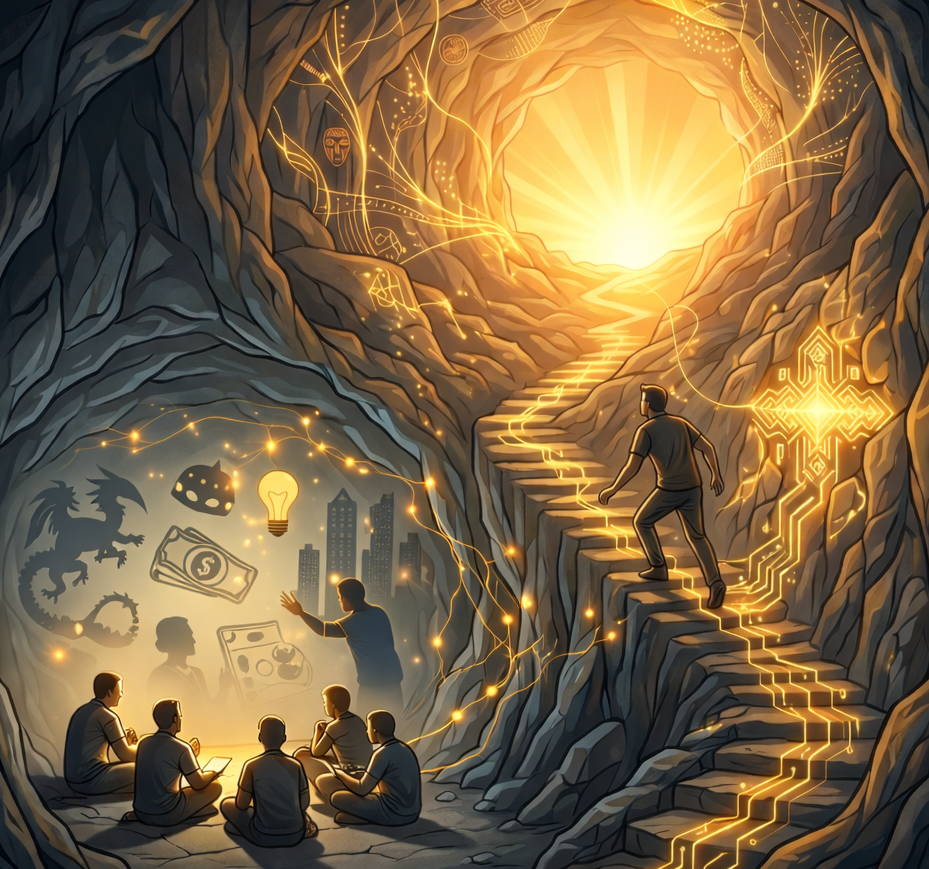
The cave of illusions, illustration by Gemini and Chat GPT
Creating conditions for learning to happen
In Plato’s Allegory of the Cave, learners are not empty vessels waiting to be filled with knowledge. They are individuals who must turn away from shadows on the wall that represent fragments of reality, projected as an illusion and begin to make sense of reality for themselves. The process is disorienting. It requires effort. And most importantly, it cannot be done for them.
Learning, in this sense, is not the transmission of knowledge. It is the reorganization of understanding. Plato and Gibran suggest it happens within all of us. Plato’s insight, much like Gibran’s, points to a simple but profound truth: The role of the teacher is not to deliver knowledge, but to create the conditions in which learners come to know.
And yet, if this is what learning is, why did that moment in my seminar feel so different from so many other experiences in university? Why are only some educators creating the conditions that make that kind of thinking possible?
In many learning environments, the emphasis is placed on outcomes, on what can be measured, graded, and compared. Under these conditions, learning becomes something to perform rather than something to experience. Students begin to orient themselves toward correctness rather than curiosity. Toward completion rather than understanding.
The internal work of learning; the questioning, the interpreting, the self-correcting becomes invisible. And this tension in education is our greatest concern. When we ask if education is ready to navigate the AI era, it really depends on whether learning is delivered of facilitated.
Our readiness to adapt might be related to how we’ve prioritized learning
We are evidently in a moment when artificial intelligence is already able to perform many of the cognitive tasks that once signaled learning, in schools. Or, did they? Perhaps the measures we’ve favored in education have only signaled competence and for so many students, that has placed them at a disadvantage. The system that favors a level of competence that technologies now provide for all of us, sorts those who can from those who can’t. Yet today, this changes to some extent. At least that kind of productive struggle is no longer required. AI generates more than a response, it has the potential to solve problems we have struggled to address, and even simulate forms of reasoning and analysis that empowers us to consider all the options. In such a world, the question is no longer simply what do students know? Or, what can students do?, but: How do students think? And, What do they wonder? What can they create? What kind of connections are they making? I am excited to think more on this, and to hear your thoughts on what we should be asking in order to shape learning design to advance human intelligence.
If thinking can be outsourced in so many ways, then the value of education must shift. It must center not on the production of answers to demonstrate knowing, but on the process by which learners come to understand, question, and direct their own thinking and the thinking process alongside artificial intelligences. There is a kind of learning that happens in moments like these that feels experimental and exploratory in ways not often valued enough, a form of thinking that is internal, reflective, and self-directed. It is when a learner begins to notice their own thinking. To question it. To adjust it. To act on it. To reflect on why it did or didn’t work and how what was learned might be applied in a new context. That kind of advanced thinking is how students are prepared to leverage technologies to improve their communities and the world.
We might call this kind of thinking, Agentic Metacognition. Which is the awareness of one’s own thinking, the capacity to shape and direct it, and the ability to move from reflection into meaningful action. This is not an abstract idea. It is something we have all experienced, even if only briefly. However, now with AI, we can slow down and experience this more frequently. We can shift to live and learn in a paradigm where this is the thinking role humans play, alongside machines. And how might we assess this kind of learning as it is in motion? Well, from what I have experienced and what I have seen at the cutting edge of EdTech, AI tools make this possible, too. First the first time in human history, we could develop tools that can monitor our growth and development in ways multiple choice tests and essays never have.
So, how do we evolve?
So our challenge now, is to first admit that there has not been consistent universal design for deep learning, across all education spaces. But we do know that education that values inquiry, conceptual understanding, context and application to lived experience, reflection and self-regulation work. So where are the education systems that center around learning how to learn? They exist. The International Baccalaureate is one of them, which is why I am passionate about my work in the organization.
The reality is, education needs to evolve quickly. The world of work is changing, and has already changed and we cannot leave it up to students to learn how to increase their agentic metacognitive abilities if classrooms continue to favor compliance, meeting expectations, and competencies that AI can deliver. The first step, if we haven’t taken it yet is to design to favor exploration, inquiry, action, and reflection for growth and development.
Using AI tools to complete writing tasks is not cheating anymore than it is cheating to use a motor vehicle rather than walk, ride a bike or a horse. Using an AI tool to initiate research is no more cheating than to use a microwave to heat up a plate of soup in 2 minutes, rather than heating it up in a saucepan over a stove.
We need to think about where learners are making decisions, where we slow down the thinking and make the process visible rather than commissioning students to go away and come back with a product. And most importantly, we need to create conditions where we explicitly develop students to be able to make connections; to who they are themselves, who they are becoming, to others who are like them and others who are not like them, and to do this they need to feel connected to what they are learning about.
This way the learning is deeply human because it is relational, emotional, and developmental. If knowledge and understanding is asleep within us, waiting for us to discover it in the way Plato and Gibran suggest, it means framing the learning so:
Learners are making sense of what they know.
They learn how to articulate what they notice about their own thinking.
All learners are given the opportunity to direct the thinking.
What I like about Plato’s shadows on the wall is they remind us to challenge our assumptions about what has been working in school. And they also remind us that to learn is human.
My hope is that we collaborate, we partner, and we support each other to evolve so that every single child can say, I am a learner. I can think. I can make sense of the world. And I know how to adapt and apply learning skills, no matter how old I am or what I’m trying to accomplish.
In short: I can direct my own learning in the world I am living in and impacting.
I am growing in confident that I too, am on this lifelong journey to trust and access my own capacity to make meaning. If you read my blog, you’re witness to that explorative learning evolution.